

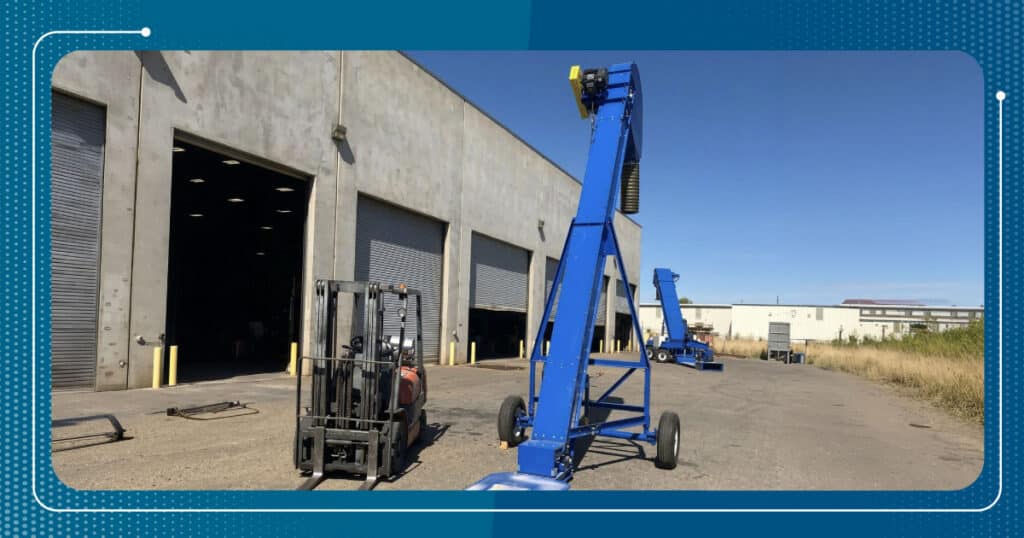
 Ports and river terminals face intense pressure to move more tons through the same footprint while tightening dust and safety standards. High‑incline and enclosed conveyors provide a compact, low‑spill backbone that can connect ships and barges to rail and truck efficiently.
The Role of High‑Incline and Enclosed Conveyors in Modern Ports
Marine terminals often start with low‑clearance holds or hoppers at dockside and must quickly climb to galleries, domes, or silos. High‑incline conveyors can make that elevation change in a short horizontal distance, reducing the need for long galleries and multiple transfer towers.
When those conveyors are enclosed and paired with dust‑controlled transfer points, they also help ports meet strict air‑quality rules and keep product off the water and wharf. That combination of vertical reach and containment is especially important for cement, fly ash, fertilizer, and other dust‑prone commodities.
Designing Shared Conveyor “Spines” That Feed Rail and Truck From Marine Intake
A powerful design strategy is to treat the high‑incline conveyor as a shared “spine” linking marine intake to inland modes. A typical layout might:
- Lift material from a dockside hopper via a high‑incline enclosed conveyor.
- Distribute it along a gallery to domes, silos, or transfer towers.
- Feed both railcar loadout tracks and truck bays from those storage points.
Using ST, L, or Z configurations, engineers can route flows to multiple modes without duplicating entire conveyor systems for each. This shared‑backbone approach lowers capital cost and simplifies maintenance while still supporting high throughput.
Handling Diverse Materials in the Same Terminal
Many multimodal terminals handle multiple commodities across seasons or contracts—such as grain, fertilizer, cement, fly ash, aggregates, and ores. High‑incline enclosed conveyors can support this diversity with:
- Appropriately selected belt materials and pocket designs.
- Clean‑out methods such as purging, wash‑down, or intermediate discharge points.
- Thoughtful segregation of flows to avoid cross‑contamination.
Standardizing on a sidewall-belt platform across commodities allows terminals to share spares and operating practices while adapting transfer‑point linings and cleaning procedures for each product.
Coordinating Throughput and Scheduling Across Modes
Conveyors at multi‑modal terminals sit between systems with very different rhythms: ships unload in large bursts, railroads deliver blocks of cars, and trucks arrive continuously. To keep everything moving, terminals must:
- Match conveyor capacity to ship and barge unloading rates, rail spot length, and truck bay count.
- Use storage (silos, domes, or ground piles) to buffer peak and valley periods.
- Coordinate start‑up, shut‑down, and mode switching through automation.
High‑incline conveyors that can run at variable speeds and feed multiple discharge points give schedulers more flexibility. With good data and control, terminals can balance berth time, rail dwell, and truck turnaround to maximize utilization.
Capex and TCO Perspective for Port and River Operators
From a financial standpoint, vertical conveying and enclosure can reduce the amount of structure, dust collection, and cleanup required by a terminal over the asset’s life. Fewer transfer points and shorter galleries translate to lower capex and less equipment to maintain.
By minimizing dust escape and spillage, enclosed systems also lower housekeeping labor, environmental risk, and potential fines. When these savings are modeled over 10–20 years, high‑incline enclosed conveyors often deliver a compelling total cost of ownership (TCO) advantage for ports and river terminals that must handle high volumes in tight spaces.
FAQs (Frequently Asked Questions)
Q1. Can the same high‑incline conveyor design serve both marine intake and rail/truck loadout?
Yes. A shared high‑incline and enclosed conveyor “spine” can lift material from dockside hoppers and distribute it to storage that feeds both rail and truck service, reducing duplicate equipment and structural costs.
Q2. How do multimodal terminals prevent cross‑contamination when using shared conveyors?
They combine commodity‑appropriate belt materials and pocket designs with rigorous cleaning, purge cycles, and well‑designed transfer points to keep different materials separate while still leveraging a common conveying platform.