

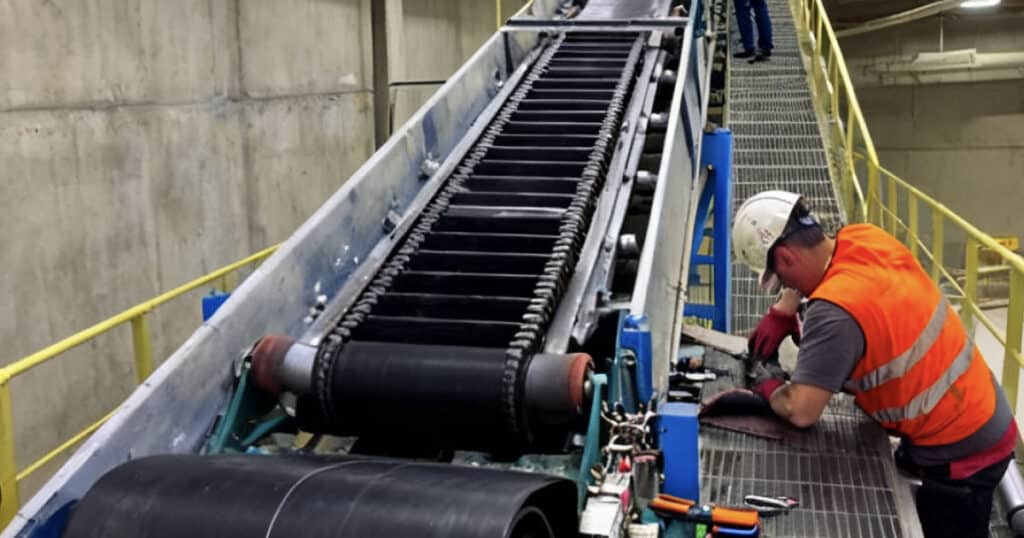
If you’re running sidewall (pocket) conveyors on steep angles—even up to near-vertical lifts—you know the problems are different and more urgent than on flatter systems. Cleat pull-off, pocket bridging, and splice failures aren’t just nuisance repairs; they stop production. This article walks through engineer-tested fixes for high-incline sidewall belts, real-world installation outcomes, and a clear checklist you can use when asking for a quote.
Why High-Incline Belts Need Special Attention
High-incline conveyors impose vertical shear and bending forces at the cleat roots and splices that flat belts never see. That means attachment method, carcass stiffness, pulley diameter, and discharge mechanics become the make-or-break factors. In practice, the goal is simple: keep pockets intact, avoid material bridging, and shed the load cleanly at the head without over-stressing the cleat roots.
Key Design Changes That Work
- Use the right carcass. For true vertical or very long high-incline lifts, choose high-modulus fabrics to limit stretch and preserve pocket geometry under load. Fabric multi-ply still works for shorter lifts where tight bend radii are needed, but confirm minimum pulley diameters first.
- Increase pulley diameters and smooth transitions. Larger-diameter drive/tail pulleys and gentle transition radii reduce the sharp bending that cracks cleat roots. Where space allows, stage the incline (several smaller angle sections) rather than a single extreme bend.
- Design positive discharge. For near-vertical heads, centrifugal-assisted discharge, tapered/vented pockets, or gentle vibratory shedding prevents bridging and ensures consistent flow off the belt.
- Upgrade splices for sidewall loads. Full-width vulcanized splices or engineered mechanical splices that carry sidewall loads evenly are essential—sealed compounds help in humid or dusty conditions.
Three Real-World High-Incline Wins (What Was Changed and What Improved)
- Cement clinker vertical lift (≈75°–90°)
Problem: Cleat detachment at the head during start/stop cycles and compacted pockets causing carryback.
Fixes: Switched to a high-tensile carcass, full-width sidewalls/cleats with reinforced roots, larger pulleys, and a positive-discharge head.
Result: Cleat failures stopped, splice life increased, no measurable carryback at discharge, and downtime dropped sharply—payback within a year. - Food-grade high-incline conveying (variable 30°–80°)
Problem: Sticky, hygroscopic powders bridged the pockets, posing a risk of contamination.
Fixes: Food-grade non-stick sidewalls, fully vulcanized hygienic splices, variable-profile pockets with vibratory assist, and sealed housings with positive purge.
Result: No contamination incidents from the conveyor, reduced cleaning cycles, and stable discharge even at steep angles.
Practical Patterns That Consistently Work
- Don’t skimp on splice quality—it’s the top predictor of long life for high-incline belts.
- Match carcass flexibility to pulley diameter: tighter pulleys require more flexible carcasses, which reduces tensile strength. Balance is critical.
- Design discharge mechanics into the belt system (not an afterthought)—positive shedding beats brute-force cleaning.
How to Measure ROI After an Upgrade
Capture baseline metrics first: unplanned downtime (hrs/month), maintenance spend, TPH, and product loss. After retrofit, compare reductions in downtime, maintenance hours, and product loss. Properly engineered high-incline upgrades commonly yield a 30–70% reduction in downtime and 2–3× longer belt life, with payback often within 6–18 months, depending on throughput and prior failure rates.
What to Include in a High-Incline Sidewall Quote Request
- Material details: sample if possible, or density, moisture range, abrasiveness, and particle-size distribution.
- Lift profile: exact lift height, incline angles for each stage, and any intermediate transitions.
- Throughput: average and peak TPH.
- Belt geometry: existing belt width, run length, pulley diameters, and sketches/photos of head/tail and idler zones.
- Failure history: describe current problems (cleat pull-off, bridging, splice issues) and uptime targets.
- Environmental notes: humidity, temperature extremes, corrosive exposure, and hygiene requirements (if food-grade).
FAQs(Frequently Asked Questions)
- Can sidewall belts handle true vertical lifts (90°)?
Yes—when designed with the right carcass (engineered high-modulus fabric),proper pulley sizing, and positive-discharge mechanics, sidewall belts can reliably operate at or near 90°. - How do you ensure positive discharge at near-vertical heads?
Use centrifugal-assisted or staged discharge heads, tapered/vented pocket floors, vibratory shedding, or combinations of these so material leaves the pocket reliably without bridging or hang-up.