

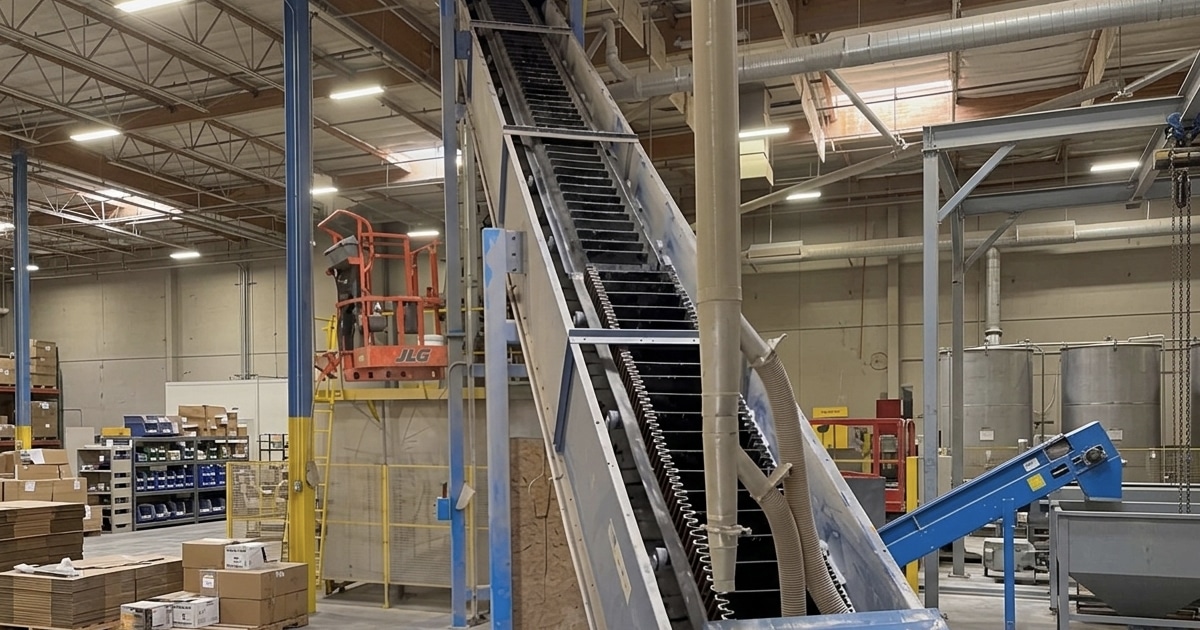
Selecting the correct sidewall conveyor belt is the single most important decision for steep-incline bulk handling—get it wrong, and you’ll see chronic spillage, cleat failure, frequent downtime, and ballooning maintenance costs. Sidewall belts work by containing material in pockets formed between vertical sidewalls and cleats, so designs must be chosen around material behavior, incline, belt carcass flexibility, cleat attachment, and transition hardware. This guide gives practical steps to pick a sidewall belt that maximizes uptime and minimizes total cost of ownership—and tells you exactly what to include when requesting a quote.
Understand Your Material First
- Abrasiveness & particle size: Abrasive, angular materials (sand, clinker, ore) wear sidewalls and cleats quickly; specify abrasion-resistant (AR) compounds and thicker sidewall faces. Fine powders increase carryback and pocket blinding—choose smoother, non-stick covers or coatings.
- Moisture & cohesion: Sticky or damp materials (wet clay, biosolids, certain grains) adhere inside pockets and to cleats. Non-stick elastomers, self-cleaning cleat profiles, or pocket vibrators often solve build-up.
- Chemical or oil exposure & temperature: Oils or aggressive chemicals degrade ordinary rubber—ask for oil- or chemical-resistant compounds; high-temp materials require heat-rated splice compounds and covers.
Actionable tip: Send a small sample or provide density, moisture range, and particle distribution with your quote request so engineers can recommend compounds.
Define Operational Parameters Precisely
- Throughput (TPH): Sidewall belts are sized by containment volume as much as by width—supply both average and peak TPH so pocket depth and cleat spacing can be calculated.
- Incline angle: Cleat height and pocket geometry depend on incline; shallow slopes use low cleats, steep runs (30°–90°+) require deep pockets, corrugated sidewalls, or full sidewall profiles.
- Speed, run length, & cycles: High speeds increase centrifugal forces; long runs add flex fatigue to sidewalls; frequent reversals or surge loads require stronger cleat attachments and robust splices.
- Environment: Indoor dusty plants, outdoor UV exposure, or wet conditions all influence compound and skirting choices.
Choose the Right Construction
- Carcass type: Fabric multi-ply provides flexibility for deep pocketing; match the carcass to the pulley diameter and run length.
- Cleat profile & spacing: Self-cleaning cleats reduce carryback for sticky materials; cleat height must balance containment with bend stresses at pulley roots.
- Splicing: For sidewall belts, full-width vulcanized splices or engineered mechanical splices that transfer sidewall loads are essential—partial or narrow splices create stress concentrations and early failures.
Don’t Forget Transition Hardware and Support
- Pulley diameter: Sidewall belts require larger pulley diameters relative to carcass flexibility to avoid excessive root flexing, which can crack cleat bases.
- Idlers & pocket support: Use idlers designed for pocketed profiles; improper support can cause uneven loading and pocket deformation.
- Skirting & sealing: Effective, adjustable skirting reduces edge abrasion and ingress, both of which damage sidewalls.
- Drive sizing: Account for pocketed mass (denser per unit length) when sizing motors—startup torque is higher than for flat belts.
Design for Maintainability
- Field repairability: Consider pre-spliced modular sections or belts designed for quick vulcanizing.
- Spare parts: Stock common splice kits, and modular sections to minimize downtime.
- Inspection access: Design transitions and access panels that allow easy inspection of pockets and splices.
Cost vs. Value
Upfront cost for custom, sidewall belts is higher, but TCO is usually lower in heavy-duty applications—expect longer life, fewer repairs, and reduced cleanup. Typical results: 20–50% lower downtime and 30–60% less maintenance spend versus poorly matched stock belts in severe apps.
What to Include in a Quote Request
- Material sample or specs (density, moisture, particle size), TPH (avg/peak), incline angles, belt width/length, current belt failures, photos of head/tail and idler zones, and uptime targets.
- Ask suppliers for compound recommendations, splice type, expected service life, and ROI projections.
Frequently Asked Questions (FAQ`s)
- Which cleat type works best on steep inclines?
Molded cleats with deep pockets and corrugated sidewalls perform best for inclines above ~30°. - How is pocket depth determined?
By required containment volume per meter (derived from TPH and material density), adjusted for packing and surge conditions.