

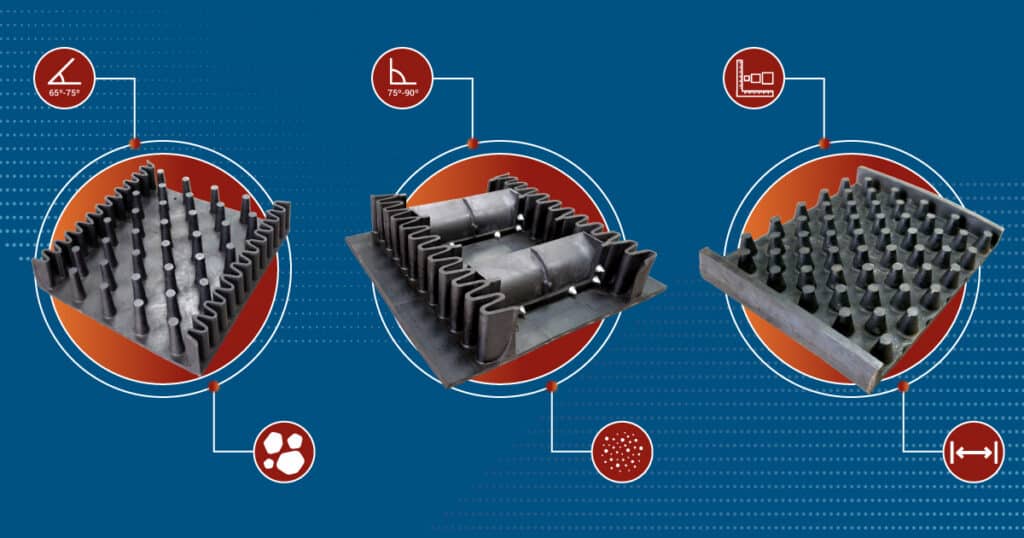
Choosing the Right Sidewall Belt Profile
Sidewall belt selection is a critical yet often overlooked part of bulk material-handling design. The right profile—CamFlex, CamWall, or CamBelt—maximizes throughput, uptime, and belt life; the wrong one can create chronic spillage, wear, and downtime.
Why Sidewall Belt Profile Selection Matters
Corrugated sidewalls and high‑profile belts enable steep and vertical conveying, especially in tight plants and transload yards. Cambelt’s one‑piece designs mold the base belt, sidewalls, and cleats or nubs in a single cure, eliminating the weak glue lines that often fail under load in traditional belts.
Each profile offers a different balance of pocket depth, flexibility, and material contact. Matching the profile to your product’s size, flow behavior, and required incline angle ensures stable conveying, minimal rollback, and lower energy consumption.
When to Choose CamFlex: High‑Incline Conveying With Nubs
CamFlex belts use molded nubs or finger‑style protrusions to grip the material and carry it up inclines of about 65–75 degrees. They shine when you need steep inclines but also want very smooth belt contact for controlled discharge and good clean‑out.
Typical CamFlex applications include:
- Steep‑incline transfer from pits to silos in cement, fly ash, or fertilizer.
- High‑incline feeds in plants where material degradation must be minimized.
- Situations where you need strong traction without deep pockets.
Because the nubs and sidewalls are part of the monolithic belt, they resist tearing and delamination even under high loads and abrasive conditions. This makes CamFlex a strong choice for operators looking to reduce emergency belt repairs and extend maintenance cycles.
When to Choose CamWall: Vertical and Near‑Vertical Lifts
CamWall belts are corrugated sidewall belts that can include cleats or buckets and are designed for conveyors with inclines up to 90 degrees. They effectively replace bucket elevators or complex multi‑conveyor cascades where vertical or near‑vertical lifts are required.
CamWall is particularly suitable for:
- Elevating powders and small granules from ground level to tall silos.
- Vertical lifts where the footprint is extremely constrained.
- Retrofits of bucket elevators with a simpler, continuous belt solution.
The combination of corrugated sidewalls and cleats creates deep pockets that lock material in during the vertical travel. Since the entire structure is molded as one piece, the cleats cannot separate from the belt carcass, a common failure mode in conventional sidewall belts that rely on secondary bonding.
When to Choose CamBelt: Compact High‑Incline Duties
Cambelt’s original high‑incline belt line—where the company gets its name—uses a smaller, 1‑inch banner sidewall with a nubbed or finger interior. These belts are ideal for compact high‑incline duties where space is tight, and the belt width is relatively small.
Use cases include:
- Short, steep transfers under limited headroom.
- Smaller capacity lines or specialty process conveyors.
- Applications where a narrow, agile belt is preferable to large pockets.
Even at this smaller scale, Cambelt’s one‑piece construction provides the same resistance to delamination and cracking as larger profiles, supporting long life in both typical and harsh environments.
Matching Belt Compounds to Temperature, Oil, and Fire Conditions
Profile is only half the story; the rubber compound must also match your operating environment. Cambelt offers sidewall belts in general-purpose, oil- and fat-resistant, heat- and cold-resistant, flame‑retardant, conductive, and food‑grade formulations.
Key selection factors include:
- Temperature: high‑heat compounds for hot materials or ambient conditions, cold‑resistant compounds for freezing climates.
- Chemical exposure: oil/fat‑resistant or chemically compatible compounds for specific products.
- Safety and compliance: flame‑retardant and conductive belts where required by regulations.
Choosing the right compound prevents hardening, cracking, swelling, or softening of the belt, all of which shorten life and can lead to unplanned downtime. When combined with the appropriate CamFlex, CamWall, or CamBelt profile, the right compound delivers a belt that runs reliably for years in demanding conditions.
Practical Selection Workflow
A simple workflow helps engineers and buyers choose the right sidewall belt:
- Define material characteristics: size, bulk density, abrasiveness, flow, and temperature.
- Map the layout: required lift height, incline angle, footprint, and transfer points.
- Choose profile: CamFlex for steep inclines with nubs, CamWall for vertical lifts, Cambelt for compact high‑incline duties.
- Select compound: match heat, oil/chemical exposure, and safety requirements.
- Validate with Cambelt engineering: confirm belt width, speed, and tension for capacity and life.
This structured approach ensures profile and compound work together, turning the belt from a commodity into a long‑term reliability asset.
FAQs(Frequently Asked Questions)
Q1. How do I decide between CamFlex and CamWall for a steep incline application?
Use CamFlex when you need steep (but not fully vertical) angles with nubbed traction and easier clean‑out; choose CamWall when you need near‑vertical or vertical lifts with deep pockets that fully contain the material.
Q2. Why is a one‑piece sidewall belt better than bonded sidewall designs?
One‑piece belts mould the base belt, sidewalls, and cleats together, eliminating weak glue or secondary‑bond interfaces that often crack and delaminate, especially on high‑incline and vertical systems, thereby significantly extending belt life and reducing unplanned downtime.