

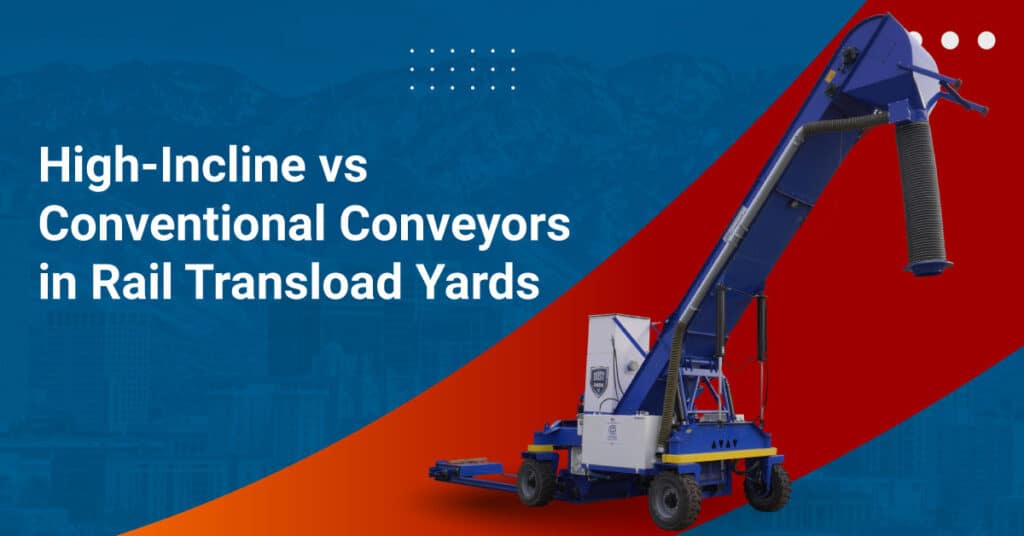
High‑incline enclosed conveyors are changing how modern rail transload yards think about footprint, dust control, and lifecycle cost. They give operators the flexibility and efficiency that large networks like Savage and Norfolk Southern look for when adding new commodities or expanding existing terminals.
Why footprint matters in rail transload yards
Transload yards are under constant pressure to move more volume through limited real estate while keeping truck access, rail spots, and storage all in play. Conventional low‑incline conveyor runs often snake across the site with long horizontal stretches and multiple transfer points, consuming valuable ground space that could otherwise be used for additional tracks, commodity lanes, or storage pads.
Savage highlights “multiple transload locations” and supply‑chain flexibility as core advantages of its network, which relies on the efficient use of every square foot at each site. Norfolk Southern’s Great Lakes Reload facility in Chicago similarly focuses on capacity and strategic footprint, with 18 indoor rail spots and dense, multi‑commodity operations under one roof. In both models, compact vertical conveying is a strategic asset, not just a mechanical detail.
High‑incline vs conventional layouts: footprint
High‑incline enclosed conveyors, such as Cambelt’s CamWall and CamFlex systems, use corrugated sidewalls, nubs and cleats molded into a single, one‑piece belt to carry bulk solids at angles of up to 70–90 degrees, depending on configuration. That allows a straight, L‑shape, or Z‑shape path that climbs quickly from railcar or pit to storage silos, domes, or loadout points in a very short horizontal distance.
By contrast, conventional low‑incline conveyors typically run at 15–20 degrees, forcing yards to use longer runs and additional transfer towers to reach the same discharge height. This spreads equipment across the site, restricts where trucks can maneuver, and makes it harder to reconfigure lanes when operators like Savage or Norfolk Southern want to add new commodities or customers to an existing transload footprint.
With high‑incline conveyance, designers can:
- Stack flows vertically and keep loadout and storage close to rail spots, similar to how Norfolk Southern uses indoor space at Great Lakes Reload to maximize throughput within a fixed building envelope.
- Free ground area for more truck lanes, staging, or a new commodity bay, helping transloaders open markets for products like cement, grain, fertilizers, and steel without acquiring more land, as seen in Savage’s expansion into Cedar City, Utah.
Dust and environmental performance
Dust control is one of the most visible operational and community issues at bulk transload yards, especially for cement, fly ash, grain, and similar fine materials. Each transfer point between conveyors can generate emissions, spillage, and housekeeping challenges, resulting in higher operating costs and regulatory risk.
Cambelt’s high‑incline systems pair one‑piece sidewall belts with enclosed conveyor designs to carry product from inlet to discharge with minimal open transfers. The belt, carcass, sidewall, and cleats are molded together in a single cure, resulting in a tougher belt and eliminating delamination points that can cause leakage or belt failure over time. Fewer transfer points and enclosed casings mean:
- Lower fugitive dust and easier compliance for sensitive materials, directly supporting the “sustainable transportation” and reduced‑emissions goals called out by Norfolk Southern and Savage when they promote rail‑centric transload solutions.
- Cleaner working areas and reduced housekeeping, which help operators maintain safe, efficient terminals even as they add volume or new product lines.
Conventional low‑incline systems with multiple transfer towers and open belt sections are harder to seal and often require additional dust collection equipment and manual clean‑up. Over time, that undermines the very cost‑savings and reliability advantages that shippers expect when they move more freight by rail through transload partners.
Maintenance, uptime, and total cost of ownership
Operators like Savage and Norfolk Southern emphasize safety, reliability, and cost efficiency as core reasons to expand their transload networks. Downtime in a yard reverberates across the supply chain, affecting train schedules, truck turns, and inventory levels. Every conveyor transfer point introduces extra idlers, pulleys, chutes, and dust systems that must be inspected, maintained, and repaired.
Cambelt’s one‑piece corrugated sidewall belts are engineered to avoid the gluing or secondary molding and pressing steps used by many conventional belt designs, which are prone to sidewall or cleat delamination under heat, abrasion, or chemical attack. By molding the base belt, carcass, sidewall, and cleats together, Cambelt removes that failure mode and extends belt life, particularly in harsh bulk environments common at transload facilities. Combined with fewer transfer points and a more compact mechanical layout, that leads to:
- Fewer components to inspect and replace, cutting both planned and unplanned maintenance hours per ton handled.
- More predictable uptime, supporting the “more dependable transportation” and “shorter dwell times” that transload operators market to their shippers.
Conventional low‑incline systems can appear cheaper at first on a per‑meter basis. However, once additional structures, transfer points, dust systems, and frequent belt repairs are factored in, the total cost of ownership often tilts in favor of a robust high‑incline enclosed design—especially over the 10–20 year lifecycle typical of rail terminals.
Flexible layouts for multi‑commodity networks
Both Savage and Norfolk Southern emphasize the ability to serve many commodities through shared infrastructure as a key value proposition. That requires transload yards to be reconfigurable; operators need to add a new product line or shift flows without rebuilding an entire conveyor network.
Cambelt’s high‑incline systems can be configured in straight, L, or Z shapes, making it easier to:
- Feed different storage silos or bins from the same railcar pit or dump point.
- Route material over existing tracks, roads, or structures without long detours or extra towers.
That flexibility mirrors how large networks expand capacity or open new markets—such as Norfolk Southern’s investment in Great Lakes Reload and Savage’s new Cedar City transload—by layering additional services onto existing footprints. A compact, reconfigurable incline conveyor helps yard designers support future‑proof layouts that align with those network strategies.
Turning conveyor choices into real supply‑chain gains
Rail shippers and transload operators adopt rail‑centric models to cut transportation costs, reach new markets, and improve resilience. Choosing between high‑incline enclosed conveyance and conventional low‑incline systems is not just an engineering decision; it shapes the footprint, safety profile, uptime, and expansion potential of every yard project.
For transload networks that want to operate more like Savage and Norfolk Southern—serving multiple commodities through shared infrastructure while keeping costs and emissions in check—high‑incline enclosed conveyors with one‑piece sidewall belts offer a powerful structural advantage. Rail‑served terminals considering a new build or upgrade can benefit from engaging Cambelt early in the design process to model inclines, transfer points, and dust‑control strategies that unlock the full value of a compact, efficient transload footprint.
Frequently Asked Questions (FAQs) :
Q1. How do high‑incline enclosed conveyors reduce the footprint of a rail transload yard?
High‑incline enclosed conveyors move material at much steeper angles than conventional low‑incline belts, reaching rail‑to‑storage elevations in far less horizontal distance. This frees up ground space for extra tracks, truck lanes, or new commodity bays, supporting the dense, multi‑commodity layouts that networks like Savage and Norfolk Southern rely on.
Q2. Why are high‑incline enclosed systems better for dust control than conventional conveyors?
High‑incline enclosed conveyors typically use fewer transfer points and carry product in covered casings from the inlet to the discharge, significantly reducing fugitive dust and spillage. Conventional low‑incline systems often require multiple open transfers and extra dust‑collection equipment, increasing emissions, housekeeping, and compliance risk at rail terminals.
Q3. How do maintenance costs compare between high‑incline enclosed and conventional conveyor systems?
Cambelt’s one‑piece corrugated sidewall belts eliminate glued or secondary‑bonded sidewalls and cleats, significantly reducing delamination and belt‑repair events over time. Combined with fewer transfer points and mechanical components, high‑incline enclosed systems generally deliver lower lifetime maintenance hours and more predictable uptime than conventional low‑incline networks spread across multiple towers.
Talk to our engineering team about your next transload incline project. Request a quote